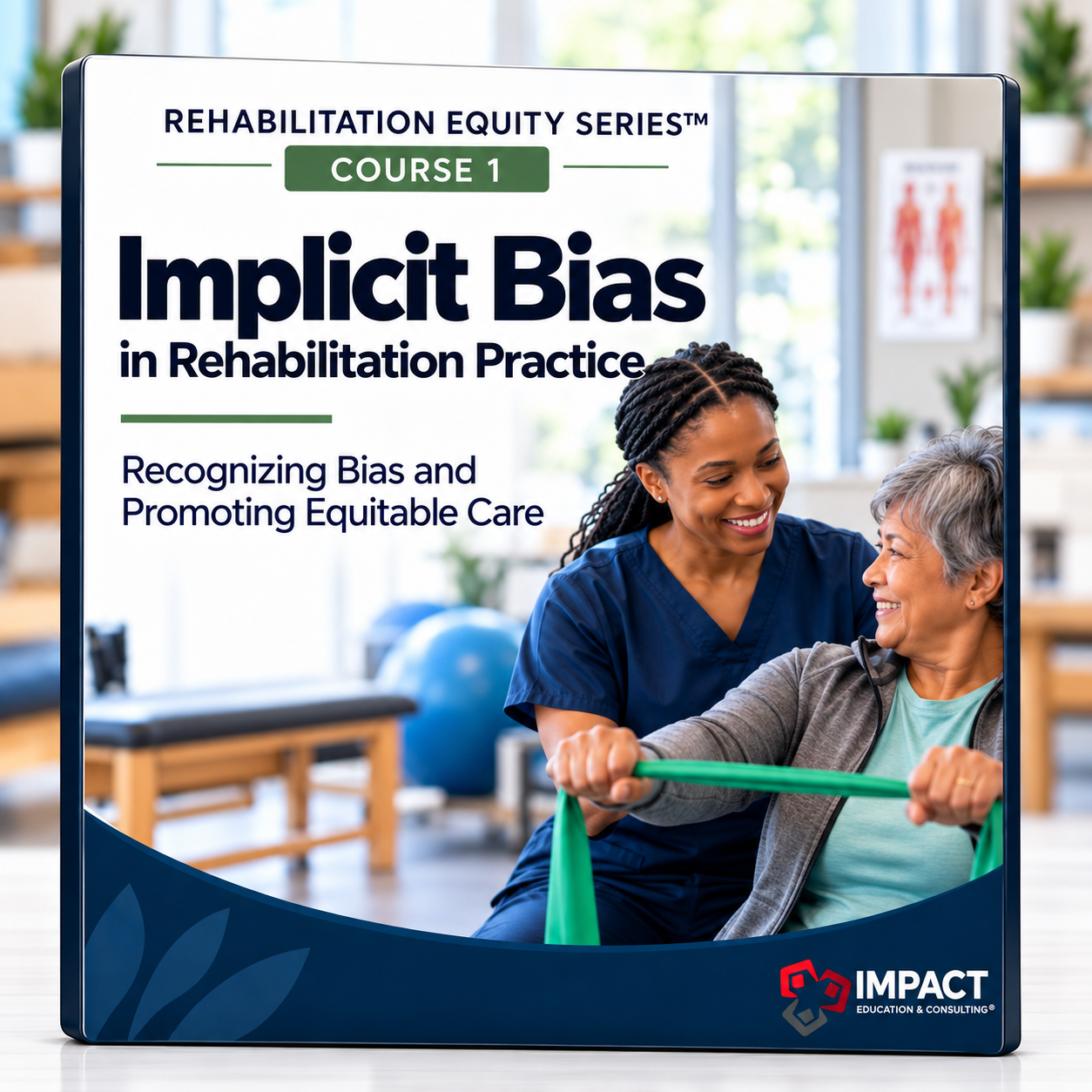
Rehabilitation Equity Series Course 1: Implicit Bias in Rehabilitation Practice (1 CEU)
$19.00
CEUs: 1 CEU | Format: Self-paced | Target Audience: Physical therapists, physical therapist assistants, occupational therapists, occupational therapy assistants, speech-language pathologists, and other rehabilitation and healthcare professionals
Approvals:
*Maryland Board of Physical Therapy Examiners #2026-471
Implicit Bias in Rehabilitation Practice: Recognizing Bias and Promoting Equitable Care
Course 1 of the Rehabilitation Equity Series™
Rehabilitation professionals make clinical decisions every day while managing complex information, competing demands, and interactions with patients, families, and healthcare teams. Within these everyday encounters, automatic attitudes and associations may influence how information is perceived, interpreted, and acted upon—even without conscious intent.
Implicit Bias in Rehabilitation Practice helps rehabilitation professionals understand what implicit bias is, how it develops, and the conditions that may increase its influence. Learners examine how unconscious assumptions may enter communication, documentation, clinical reasoning, treatment planning, and patient engagement while distinguishing implicit bias from explicit bias and intentional discrimination.
Through realistic rehabilitation examples and focused clinical scenarios, learners will practice separating observations from assumptions, identifying information that may be missing, and recognizing opportunities for greater reflection during patient care. The course concludes by applying the 3Rs of Equitable Rehabilitation™—Recognize, Reflect, Respond and identifying practical habits that support objective, evidence-informed, patient-centered, and equitable care in everyday clinical encounters.
Course Learning Objectives
Upon completion of this course, learners will be able to:
- Define implicit bias and distinguish it from explicit bias and intentional discrimination.
- Explain how implicit bias develops and how it may influence communication, clinical reasoning, and interactions with patients, families, and healthcare teams.
- Recognize situations in rehabilitation practice where implicit bias may influence clinical decision-making, patient engagement, documentation, or care planning.
- Apply the 3Rs of Equitable Rehabilitation™—Recognize, Reflect, Respond to support objective, evidence-informed, and patient-centered clinical decision-making.
- Identify practical strategies that promote equitable, respectful, and patient-centered rehabilitation care while strengthening therapeutic relationships and supporting positive patient outcomes.
Who Should Take This Course?
This course is designed for physical therapists, physical therapist assistants, occupational therapists, occupational therapy assistants, speech-language pathologists, athletic trainers, and other rehabilitation and healthcare professionals seeking to strengthen their awareness of implicit bias and incorporate practical strategies that support equitable, respectful, and patient-centered care.
Related products
-
Courses
Preventing Medical Errors in Therapy Practice [20-1343689] (2 CEU)
Original price was: $29.00.$19.00Current price is: $19.00.
![Preventing Medical Errors in Therapy Practice [20-1343689] (2 CEU)](https://impacteducationconsulting.com/wp-content/uploads/2025/12/ChatGPT-Image-Sep-29-2026-10_46_54-AM-300x300.png)
Reviews
There are no reviews yet.